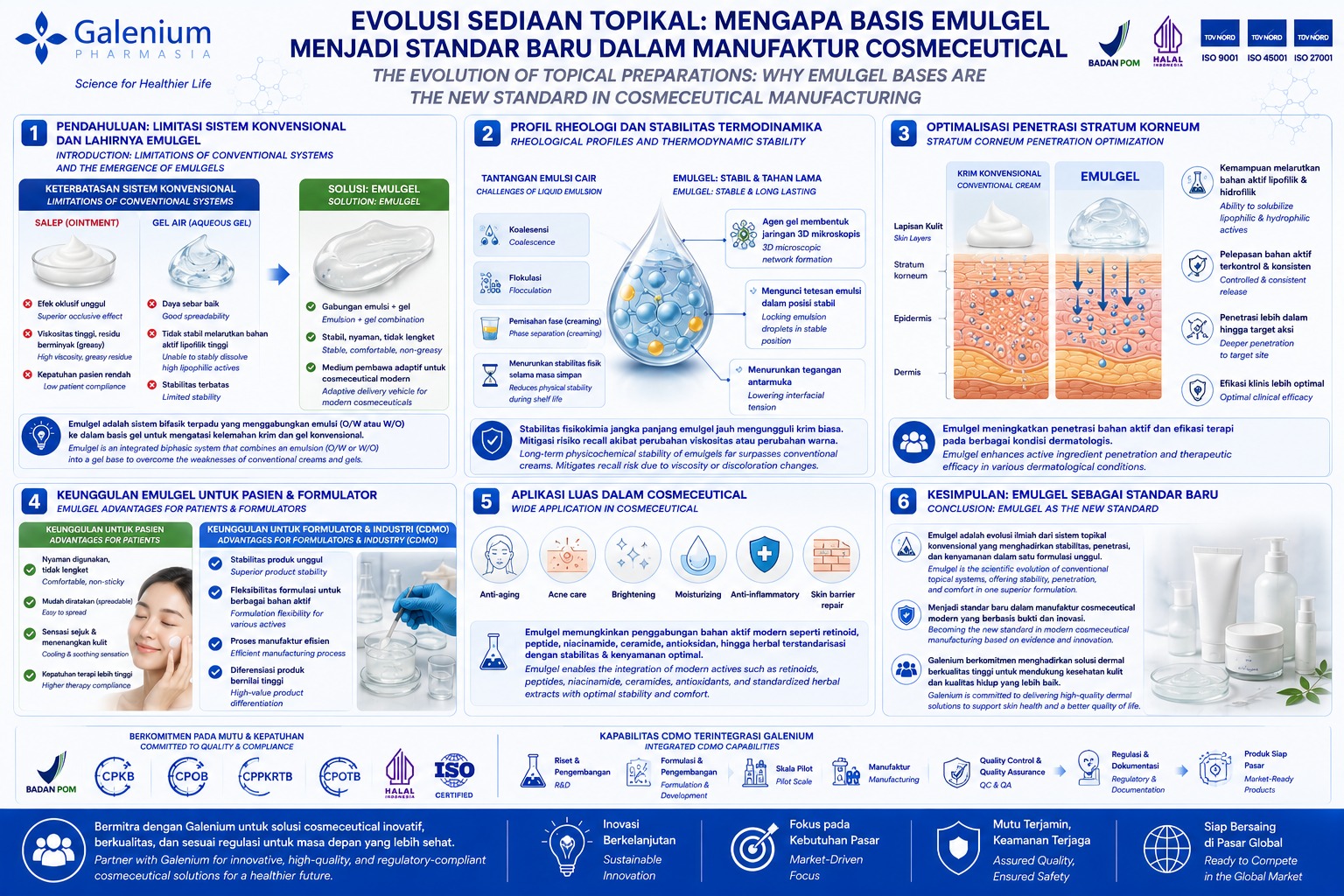
1. Introduction: Limitations of Conventional Systems and the Emergence of Emulgels
Historically, the development of topical preparations was dominated by ointment bases, characterized by dense hydrocarbons, and creams (liquid emulsions). Although ointments offer superior occlusive effects to prevent skin dehydration, their excessive viscosity leaves a greasy residue that severely diminishes patient compliance. Conversely, pure water-based gel formulations offer elegant spreadability but face a fatal technical constraint: hydrophilic gels are fundamentally incapable of stably dissolving highly lipophilic (hydrophobic) active ingredients (Sengupta & Chatterjee, 2017).
To bridge this gap, pharmaceutical engineering conceptualized the emulgel (emulsion-gel) system. By definition, an emulgel is an integrated biphasic system wherein a classical emulsion (either oil-in-water/O-W or water-in-oil/W-O) is incorporated into a gel base. This formulation architecture elegantly eliminates the structural weaknesses of both conventional emulsions and pure gels, rendering it a highly adaptive delivery vehicle for the modern cosmeceutical sector (Khan et al., 2020).
2. Rheological Profiles and Thermodynamic Stability
The industrial success of emulgels is heavily supported by their thermodynamic stability profiles. Liquid emulsions frequently suffer from physical instability phenomena such as coalescence (the merging of oil droplets), flocculation, or phase separation (creaming) during their shelf-life. The incorporation of gelling agents, such as polyacrylic acid polymers (carbomers), cellulose derivatives, or natural polysaccharide polymers, drastically modifies the rheology of the external phase (Monga et al., 2021).
These polymers construct a microscopic three-dimensional network that locks the emulsion droplets in an evenly distributed, static position. This steric mechanism substantially lowers the interfacial tension, providing long-term physicochemical stability that far surpasses conventional cream formulations (Sengupta & Chatterjee, 2017). For the manufacturing industry (CDMOs), this stability mitigates the risk of product recalls triggered by viscosity degradation or discoloration during distribution across the supply chain.
3. Stratum Corneum Penetration Optimization
Within the cosmeceutical realm, high-impact active ingredients—such as retinoid derivatives (retinol, adapalene), tocopherols (Vitamin E), salicylic acid, and various phytopharmaceutical botanical extracts—exhibit purely lipophilic traits. The primary challenge is penetrating the stratum corneum (the outermost skin layer), which acts as a barrier against hydrophilic molecules. Emulgels facilitate a highly efficient dual-delivery mechanism (Khan et al., 2020).
The internal oil phase dissolves lipophilic active ingredients with substantial capacity. Simultaneously, the external gel phase intensively deposits moisture (hydration) onto the epidermal surface. Optimally hydrated skin induces temporary swelling of the corneocytes, expanding the intercellular spaces, and ultimately creating diffusion pathways that allow drug molecules to penetrate the skin tissue more rapidly and uniformly (Monga et al., 2021).
4. Cosmetic Aesthetics and Consumer User Experience
From a marketing standpoint (B2B and B2C), clinical efficacy will not generate sustainable sales if product texture is disregarded. The greatest commercial advantage of emulgels lies in their tactile sensation. These formulations possess thixotropic properties—where the solid gel matrix instantaneously becomes more fluid (shear-thinning) upon the application of mechanical stress, such as rubbing on the skin surface (Alexander et al., 2013).
This characteristic yields a soothing cooling effect, excellent spreadability, rapid absorption, a matte finish, and non-comedogenic properties. For dermo-cosmetic brands, transitioning formulations towards emulgels has proven to radically elevate consumer satisfaction metrics, particularly within the acne-prone patient segment and the well-aging consumer demographic (Alexander et al., 2013).
5. Manufacturing Scalability Challenges (Scale-Up Engineering)
Despite its absolute formulation advantages, translating emulgel production from a laboratory scale to industrial manufacturing lines presents steep technical challenges. The most persistent challenge is the risk of aeration—microscopic air bubbles entrapped within the gel polymer matrix during the high-shear mechanical mixing process. Air bubbles not only ruin the product's visual appearance but also trigger premature oxidative reactions in the active ingredients (Monga et al., 2021).
Furthermore, thermodynamic control is a critical parameter. The blending of thickening agents and emulsion fixation must be executed at highly specific temperature profiles to prevent the denaturation of the polymer network. Production facilities must invest in closed-loop tank reactors equipped with integrated vacuum homogenizers to disperse polymers homogeneously and instantaneously eliminate air while the product is blended (Sengupta & Chatterjee, 2017).
6. Integrated CDMO Solutions at PT Galenium Pharmasia Laboratories
Emulgel formulation innovations require the convergence of material science expertise and advanced machinery infrastructure. PT Galenium Pharmasia Laboratories has anticipated this trend curve by modernizing our semi-solid engineering capacities across our production lines. Our Formulation and Research (R&D) department possesses extensive capabilities in selecting polymer rheological profiles—ranging from Carbomer derivatives and Xanthan Gum to polymeric emulsion stabilizing agents—to tailor specific textures that align with our B2B clients' product blueprints.
Through our Toll Manufacturing facilities, fully certified in Good Manufacturing Practices for Pharmaceuticals (CPOB) and Cosmetics (CPKB), Galenium operates large-capacity vacuum homogenizers ensuring every emulgel batch is aeration-free and perfectly dispersed. We eliminate the trial-and-error scale-up risks frequently encountered by brand owners, guaranteeing that your cosmeceutical innovations can be mass-produced with high efficiency, stable quality consistency, and are primed to dominate the modern medical beauty market landscape.
References
- Alexander, A., Dwivedi, S., Ajazuddin, Giri, T. K., Saraf, S., Saraf, S., & Tripathi, D. K. (2013). Approaches for breaking the barriers of drug permeation through transdermal drug delivery. Journal of Controlled Release, 164(1), 26-40.
- Khan, B. A., Ullah, S., Khan, M. K., Alshahrani, S. M., & Braga, V. A. (2020). Formulation and evaluation of Ocimum basilicum-based emulgel for wound healing using animal model. Saudi Pharmaceutical Journal, 28(12), 1842-1852.
- Monga, P., Saini, V. K., Kamboj, S., & Arora, R. (2021). Emulgel: A novel approach to topical drug delivery. International Journal of Applied Pharmaceutics, 13(4), 16-24.
- Sengupta, P., & Chatterjee, B. (2017). Potential and future scope of nanoemulgel formulation for topical delivery of lipophilic drugs. International Journal of Pharmaceutics, 526(1-2), 353-372.