1. Introduction: Clinical Significance and B2B Perspectives of Rectal Formulations
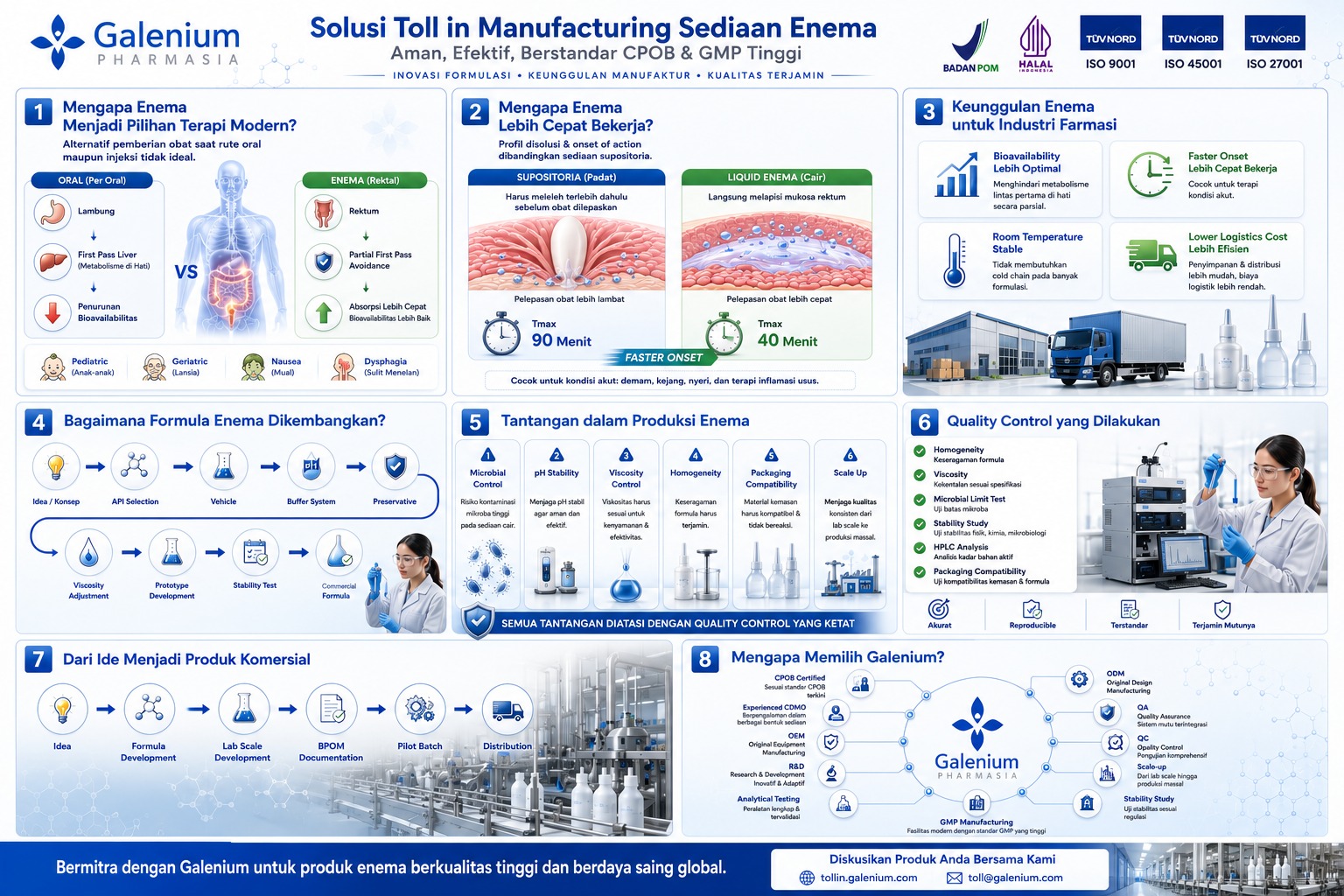
In the pharmaceutical industry, the development of rectal drug delivery routes, particularly enema formulations, represents a strategic area requiring high specialization. This route serves as a crucial alternative when oral or intravenous administration is limited, such as in pediatric and geriatric patients, or those suffering from dysphagia and chronic nausea (Asian Journal of Research in Pharmaceutical Sciences, 2012). Physiologically, the rectum provides a relatively stable environment with lower proteolytic enzyme activity compared to the upper gastrointestinal tract (Hua, 2019; PMC6805701). This characteristic minimizes the risk of degradation of active pharmaceutical ingredients before they are absorbed by the body.
A primary pharmacokinetic advantage of the rectal route is its ability to partially bypass hepatic first-pass metabolism. This allows active ingredients to enter the systemic circulation directly, potentially enhancing drug bioavailability (Hua, 2019; PMC6805701). For B2B partners, expanding into an enema product portfolio offers competitive market differentiation, responding to the high medical demand for bowel inflammation therapies and other emergency treatments.
Nevertheless, the formulation and manufacturing stages of enemas demand complex technical precision. Parameters such as lipophilicity and partition coefficient must be accurately calibrated to optimize cellular absorption (Asian Journal of Research in Pharmaceutical Sciences, 2012). As an experienced Contract Development and Manufacturing Organization (CDMO), PT Galenium Pharmasia Laboratories provides comprehensive technical solutions. With specialized industrial-scale facilities, we facilitate OEM and ODM partners in producing enema formulations that meet clinical efficacy standards and Good Manufacturing Practice (GMP) compliance.
2. Bioavailability Profile: Liquid Formulations versus Solid Suppositories
Comparative evaluations in biopharmaceutical literature indicate that liquid or foam enema formulations exhibit a more efficient dissolution profile compared to solid suppositories. Liquid formulations are designed to accelerate drug release, thereby resulting in a shorter onset of action. This characteristic is highly relevant for the management of acute conditions, such as seizure control, fever reduction (antipyretic), and analgesic therapy (Prasaja et al., Drug Research, 2021).
Pharmacokinetic studies validate this difference. For instance, the administration of ibuprofen in enema form has been shown to reach peak plasma concentration (Tmax) in a median time of 40 minutes, compared to 90 minutes for suppository formulations (Prasaja et al., Drug Research, 2021). This rapid absorption is facilitated because the liquid directly coats a large surface area of the rectal mucosa. Conversely, suppository formulations require additional melting time at body temperature before releasing the active ingredients (Asian Journal of Research in Pharmaceutical Sciences, 2012).
From an operational and supply chain perspective, enema formulations offer more adaptive thermal stability at room temperature. Unlike many suppositories that require cold chain distribution to prevent product deformation, the stability of liquid enemas can reduce logistical cost burdens (Prasaja et al., Drug Research, 2021). The Research & Development (R&D) department at Galenium masters the formulation technology of buffer and preservative systems to ensure the integrity of the preparation is maintained throughout its shelf life.
3. Formulation Developments: Targeted and Natural Ingredient Approaches
The development of rectal formulations is now transitioning towards specific drug delivery systems. Preclinical research indicates the potential application of enemas in the management of Inflammatory Bowel Disease (IBD). Recent studies evaluating the combination of Cannabidiol (CBD) and Sodium Propionate in an enema base have proven to exert synergistic anti-inflammatory effects. This approach measurably reduces the severity of intestinal lesions and preserves mucosal structure compared to single-agent administration (Naftali et al., Tel Aviv University, 2023).
In addition to synthetic compounds, formulation exploration also encompasses the standardization of botanical extracts. Research on herbal decoction enemas, such as Huangkui lianchang, notes their efficacy in facilitating mucosal healing in mild to moderate ulcerative colitis cases, with clinical remission rates reaching 70%–85% (Chen et al., Journal of Pain Research, 2026). This data opens opportunities for industry players to develop lines of Standardized Herbal Medicines (OHT) or phytopharmaceuticals in rectal dosage forms.
Technical challenges arise when handling active ingredients sensitive to hydrolysis or environmental pH changes (Asian Journal of Research in Pharmaceutical Sciences, 2012). To mitigate the risk of degradation, Galenium Pharmasia's R&D team implements strict controls over viscosity modifiers and preparation pH parameters, ensuring that all active components remain stable and effective up to the product's expiration date.
4. Quality Control and Stability Parameters
The integrity of liquid products demands extensive quality control (QC) testing parameters. Compared to solid preparations, water-based formulations are more susceptible to microbial contamination profiles and physicochemical stability fluctuations. Routine evaluations for enema preparations include homogeneity analysis, determination of specific viscosity (to ensure retention of the preparation in the rectal cavity), and strict monitoring of microbial limit test (Hua, 2019; PMC6805701).
The transition from laboratory to commercial scale (scale-up) is often a critical point, particularly concerning the compatibility of excipients in large volumes. Furthermore, the primary packaging system plays a determinant role. The selection of bottle and applicator materials must be validated to have no interactivity with the liquid medication, thereby avoiding the risk of chemical release from the packaging (leaching) or adsorption of active ingredients by the packaging (Asian Journal of Research in Pharmaceutical Sciences, 2012).
PT Galenium Pharmasia Laboratories operates current analytical instruments (such as high-performance liquid chromatography/HPLC) to verify the stability profile of every production batch. This process is supported by structured packaging material vendor qualifications and primary packaging compatibility testing. This analytical approach aims to minimize the risk of product recalls and ensure the final product complies with pharmacopeial quality standards.
5. GMP Operational Standards and CDMO Manufacturing Support
All technical capabilities are founded on compliance with Good Manufacturing Practice (GMP) guidelines. Based on BPOM Regulations, the implementation of the GMP quality system serves as a preventive instrument ensuring products are consistently produced and controlled according to quality standards relevant to their intended use (BPOM, 2011). This approach eliminates risks that cannot be detected solely through finished product testing.
BPOM regulations require every production facility unit to hold a specific GMP Certificate based on the dosage form. Given that enema preparations are aqueous liquids, the manufacturing facility must be equipped with controlled-pressure cleanroom specifications, certified heating, ventilation, and air conditioning (HVAC) systems, and validated cleaning validation protocols to mitigate the risk of cross-contamination (BPOM, 2011).
The possession of GMP certification on PT Galenium Pharmasia Laboratories' production lines represents our process integrity standards. To support clients' business dynamics—such as production capacity scale-ups or packaging parameter modifications—our Quality Assurance (QA) department proactively manages the change control system and regulatory impact assessments. Through Contract Manufacturing services, Galenium Pharmasia invites industry partners to optimize operational efficiency. Business partners can focus on marketing and distribution strategies, while manufacturing operations are executed in accordance with the highest regulatory compliance standards.
References
- Hua, S. (2019). Physiological and Pharmaceutical Considerations for Rectal Drug Formulations. Frontiers in Pharmacology, 10, 1196. https://pmc.ncbi.nlm.nih.gov/articles/PMC6805701/
- Garg, T., et al. (2012). Rectal drug delivery: A promising route for enhancing drug absorption. Asian Journal of Research in Pharmaceutical Sciences, 2(4).
- Prasaja, B., et al. (2021). Rectal Administration of Ibuprofen: Comparison of Enema and Suppository Form. Drug Research.
- Naftali, T., & Sagiv, S. P. (2023). A novel enema formulation containing cannabidiol and sodium propionate for ulcerative colitis: preclinical assessment in a murine model. Tel Aviv University.
- Chen, Y., et al. (2026). The effectiveness of huangkui lianchang decoction enema solution in the treatment of ulcerative colitis. Journal of Pain Research, 2026(19). Dove Medical Press.
- Badan Pengawas Obat dan Makanan (BPOM) Republik Indonesia. (2011). Peraturan Kepala Badan Pengawas Obat dan Makanan Republik Indonesia Nomor HK.04.1.33.12.11.09937 Tahun 2011 Tentang Tata Cara Sertifikasi Cara Pembuatan Obat Yang Baik.