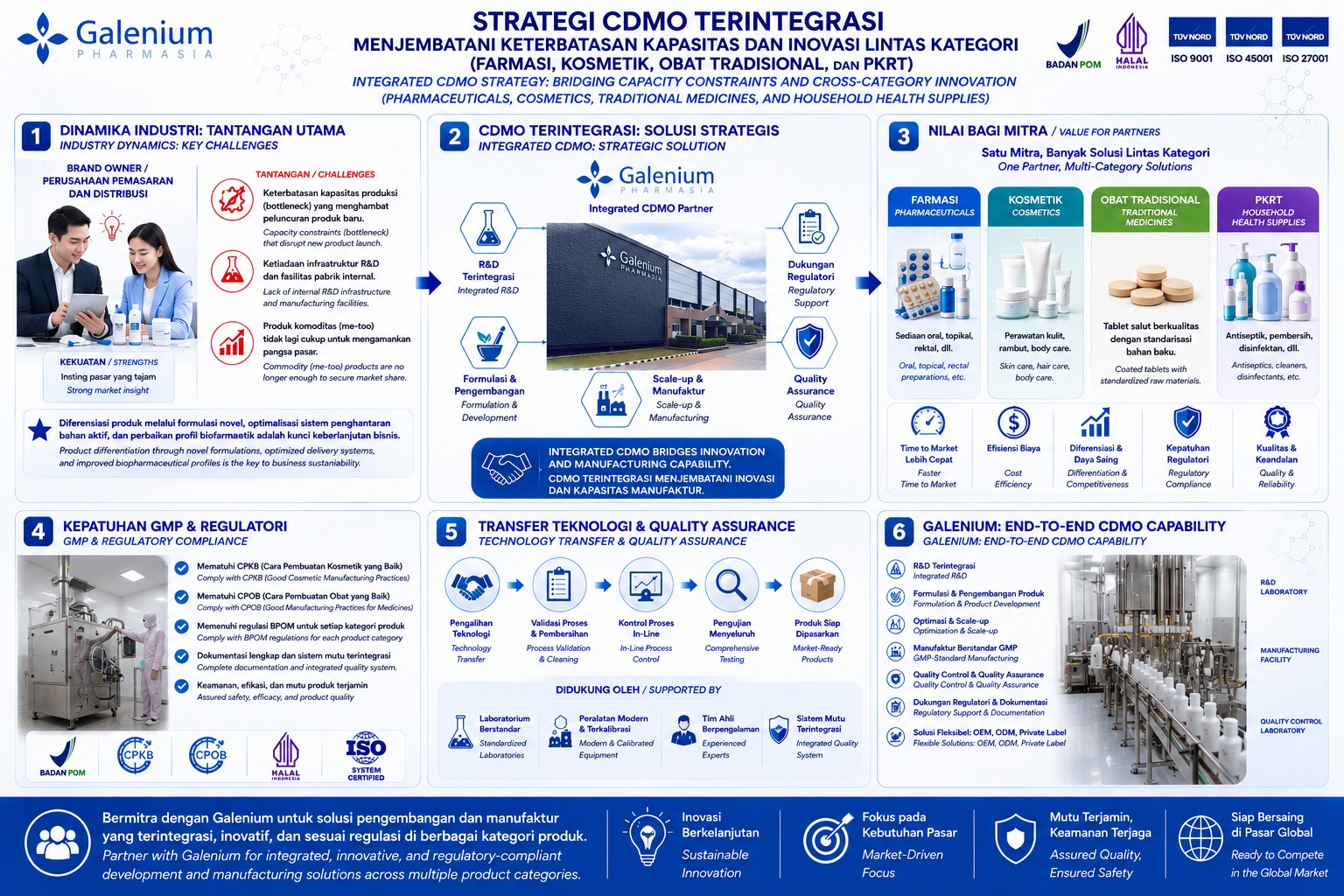
1. Industry Dynamics: Navigating Capacity Constraints and the Innovation Imperative
The healthcare and personal care sectors currently face a fiercely competitive landscape. Many manufacturing facilities grapple with maximized equipment utilization (bottlenecks), which inevitably delays new product launch schedules. Conversely, marketing and distribution companies (brand owners) often possess astute market acumen but are constrained by the lack of internal research and development (R&D) infrastructure and manufacturing facilities (MacPherson & Maughan, 2015). This situation creates a significant operational gap within the industry.
In responding to dynamic consumer demands, relying merely on commodity products (me-too products) through conventional white-labeling schemes is no longer sufficient to secure market share. Product differentiation—whether through novel formulations, optimization of active ingredient delivery systems, or improved biopharmaceutical profiles—is the catalyst for business sustainability (Munos, 2009). Therefore, partnering with a Contract Development and Manufacturing Organization (CDMO) equipped with an integrated R&D department becomes a rational strategic imperative to delegate technical burdens without sacrificing a company's innovation capacity.
2. Pharmaceutical and PKRT Innovation: Converging Efficacy and Regulatory Compliance
The development of pharmaceutical products and Household Health Supplies (PKRT) demands high scientific precision. In the pharmaceutical realm, innovating new delivery routes—such as transitioning from conventional oral forms to topical or controlled-release rectal preparations— necessitates comprehensive physicochemical stability analysis and dissolution profile evaluation (Lombardino & Lowe, 2014). These advanced formulation discoveries must be meticulously validated before proceeding to clinical or bioequivalence testing phases.
Meanwhile, the development of modern PKRT, such as high-performance antiseptics or enzymatic cleaning agents, requires equally stringent quality standardization. Regulations mandate that these formulations possess optimal pathogen-eradicating capabilities while maintaining a toxicological profile safe for human and environmental exposure (Kementerian Kesehatan RI, 2017). CDMO facilities are required to possess excipient engineering capabilities to harmonize the stability of antimicrobial agents with their accompanying surfactant systems.
3. Cosmetic and Traditional Medicine Expansion: Transitioning from Empirical Practices to Clinical Standardization
The cosmetics sector is experiencing a paradigm shift towards the cosmeceuticals realm, where the boundary between aesthetic care functions and therapeutic interventions is becoming increasingly indistinct. The market and aesthetic practitioners progressively demand products formulated with high-percentage active ingredients (e.g., peptides, ceramides, or hydroxy acids) supported by a preservative system that does not disrupt the stratum corneum (Barel, Paye, & Maibach, 2014). Such advanced cosmetic formulations require precision manufacturing technologies, like microemulsions or liposome encapsulation, to ensure the viability of active ingredients prone to thermal or oxidative degradation.
In parallel, the trajectory of Traditional Medicines (OT) in Indonesia is directing away from empirical-based jamu preparations towards Standardized Herbal Medicines (OHT) and Phytopharmaceuticals grounded in preclinical/clinical trials. The extraction process of botanical secondary metabolites requires strict standardization of both specific and non-specific extract parameters to guarantee the consistency of pharmacological efficacy across every production batch (BPOM, 2021). Distribution entities frequently encounter technical hurdles in executing these extraction and formulation phases due to a lack of access to advanced analytical instruments, such as HPLC or spectrophotometry.
4. Cross-Sector Quality Validation and Regulatory Compliance Integrity
Translating research innovation into commercial viability strictly requires compliance with nationally and internationally recognized regulatory guidelines. The commercialization stage mandates every fabrication facility to operate under the umbrella of category-specific Good Manufacturing Practices (GMP). In Indonesia, these parameters are represented by the certification requirements of CPOB for pharmaceuticals, CPKB for cosmetics, CPOTB for traditional medicines, and CPPKRT for household health supplies (BPOM & Ministry of Health RI).
The Quality Assurance (QA) architecture within a CDMO entity serves as a guarantor that the technology transfer process—from laboratory inception to mass production (scale-up)— proceeds seamlessly. The execution of process validation, machine performance qualification, and accelerated stability testing are absolute procedures. This approach ensures that an innovative formula design can be mass-replicated with physical and chemical specifications precisely matching its initial prototype (MacPherson & Maughan, 2015).
5. Holistic R&D and Manufacturing Capabilities at PT Galenium Pharmasia Laboratories
In addressing the complexity of these industry challenges, PT Galenium Pharmasia Laboratories transforms beyond a conventional toll manufacturer, positioning itself as a comprehensive end-to-end product development partner. Our Research and Development department is fortified by competent formulators and supported by next-generation analytical instruments, enabling us to orchestrate formulation design, pre-formulation evaluation, and primary packaging interaction studies across the spectrum of categories: Pharmaceuticals, Cosmetics, Traditional Medicines, and PKRT.
We exist to bridge distribution companies seeking portfolio expansion, as well as peer manufacturing firms aiming to mitigate operational capacity constraints. Armed with an integrated and comprehensively certified fabrication ecosystem—CPOB, CPKB, CPOTB, and CPPKRT—Galenium Pharmasia offers strategic flexibility for B2B partners. From the purification of standardized herbal extracts and the fabrication of dermatological-grade cosmetics to the production of precision pharmaceutical preparations, every innovation we facilitate is consistently guarded by top-tier manufacturing integrity.
References
- Barel, A. O., Paye, M., & Maibach, H. I. (2014). Handbook of Cosmetic Science and Technology (4th ed.). CRC Press.
- Badan Pengawas Obat dan Makanan (BPOM) Republik Indonesia. (2021). Peraturan BPOM Nomor 17 Tahun 2021 tentang Pedoman Pembuatan Obat Tradisional yang Baik.
- Badan Pengawas Obat dan Makanan (BPOM) Republik Indonesia. (2020). Peraturan BPOM Nomor 31 Tahun 2020 tentang Persyaratan Mutu Kosmetika dan Pedoman CPKB.
- Kementerian Kesehatan Republik Indonesia. (2017). Peraturan Menteri Kesehatan RI Nomor 20 Tahun 2017 tentang Cara Pembuatan Perbekalan Kesehatan Rumah Tangga yang Baik.
- Lombardino, J. G., & Lowe, J. A. (2014). The role of the medicinal chemist in drug discovery— then and now. Nature Reviews Drug Discovery, 3(10), 853-862.
- MacPherson, C., & Maughan, E. (2015). Outsourcing pharmaceutical manufacturing: A strategic approach. Pharma Manufacturing Journal.
- Munos, B. (2009). Lessons from 60 years of pharmaceutical innovation. Nature Reviews Drug Discovery, 8(12), 959-968.